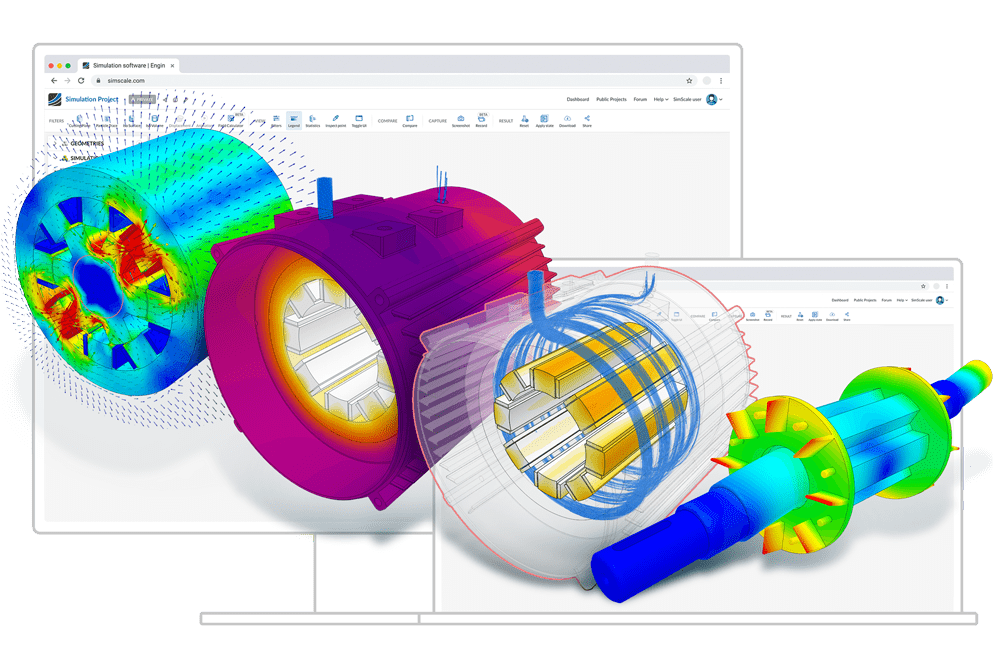
Know How Your Design Performs — Before It's Ever Built
Simulate real-world loads, heat, vibration and flow directly
on your CAD models — and catch design weaknesses on screen,
long before they reach a prototype. Fewer physical builds.
Faster validation. Products that perform the way you designed
them to.
For decades, the only way to know how a product would really perform was to build it, test it, and find out what broke. That approach still works — but it's slow, expensive, and it puts the biggest discoveries at the end of the process, when changes cost the most.
Simulation and engineering analytics shift that discovery earlier. Instead of design → build → test → fail → redesign, teams now design → simulate → validate → optimize → build with confidence. The physical prototype still has a role, but it becomes a final confirmation step, not a guessing exercise.
For engineering and product teams evaluating this shift, the question isn't whether digital validation is useful — it's how quickly it can be applied to the designs sitting on their desks right now.
Fewer physical iterations
Catch geometry and material issues before a mold, die, or prototype is ever cut.
Earlier design confidence
Know how a part will behave under load, heat, or vibration during the design phase, not after.
Data-driven decisions
Compare design options on evidence — stress, temperature, flow, fatigue life — instead of intuition alone.
What & Why Section — Engineering Simulation & Analysis
What Is Simulation & Engineering Analysis?
In plain terms: simulation software creates a digital, mathematical model of your product and then tests it against real-world conditions — forces, heat, vibration, airflow, fatigue cycles — without building anything physical. Engineering analysis takes the results of those virtual tests and turns them into data you can act on: where a design is strong, where it's weak, and what to change.
Think of it as a wind tunnel, load rig, and thermal chamber that live inside your computer — one that lets you study how a product will behave under conditions it hasn't physically experienced yet.
Why Use Simulation Before You Build?
01
Predict performance
See how a design behaves under real operating loads before it exists physically.
02
Detect issues early
Find weak points, stress risers, and failure modes while changes are still cheap.
03
Reduce physical prototypes
Use physical builds to confirm a design, not to discover its problems.
04
Improve design decisions
Compare multiple design options on real engineering data, not assumptions.
05
Optimize materials & geometry
Remove unnecessary mass or cost while keeping the performance you need.
06
Reduce engineering costs
Fewer rebuild cycles and less rework across the development timeline.
07
Accelerate development
Shorten the path from concept to a validated, manufacturable design.
08
Improve reliability
Ship products with a clearer understanding of how and when they might fail.
The Shift Section — Engineering Simulation & Analysis
The Shift
From Trial-and-Error to Simulation-Driven Development
The traditional workflow and the simulation-driven workflow can start from the same design intent — but they arrive at very different costs, timelines, and outcomes.
Traditional Approach Slower · Costlier
01Design the component based on experience and prior products.
02Build a physical prototype.
03Test it under lab or field conditions.
04Identify issues — often after real damage or failure. ⚠ found late
05Redesign based on what broke.
06Rebuild a new prototype from scratch. ↻ repeat cycle
07Retest and hope the fix worked.
Result: increased cost, schedule risk, and repeated rework.
Simulation-Driven Approach Faster · Confident
01Design the component in your existing CAD environment.
A single, connected set of simulation capabilities to study how your product behaves structurally, thermally, in motion, and in the flow of fluids or air — before it's built.
Structural Analysis
Covers static structural, dynamic, nonlinear, and buckling analysis — how a part or assembly holds up under steady loads, sudden forces, large deformation, or compressive instability.
Answers: Will this part survive its real operating loads without breaking, bending, or buckling?
Fatigue Analysis
Predicts how repeated loading and stress cycles wear down a component over its working life, long before cracks or failures would appear physically.
Answers: How many load cycles can this component survive before fatigue failure?
Modal & Vibration Analysis
Identifies a structure's natural frequencies and mode shapes to flag resonance risks before they cause noise, fatigue, or catastrophic vibration failure.
Answers: Will this structure resonate dangerously with its operating environment?
Thermal & Heat Transfer Analysis
Models how heat is generated, conducted, and dissipated through a component or enclosure, including steady-state and transient thermal behavior.
Answers: Will this product overheat, and how does temperature affect its performance and lifespan?
Computational Fluid Dynamics (CFD)
Covers flow analysis and electronics cooling — how air, liquid, or gas moves around or through a product, including pressure drop, turbulence, and airflow patterns.
Answers: How does fluid or air movement affect drag, cooling, pressure, or performance?
Motion Analysis
Simulates moving mechanisms and assemblies — linkages, gears, cams — to study forces, velocities, and interactions between moving parts.
Answers: Will this mechanism move, interact, and transmit force the way it's intended to?
Design Optimization
Automatically explores design variations — geometry, material, thickness — to find the configuration that best balances performance, weight, and cost.
Answers: What's the lightest, most efficient design that still meets every performance requirement?
Product Performance & Engineering Data Analysis
Brings simulation results together into clear, comparable data — so teams can track performance across design iterations and make evidence-based decisions.
Answers: Which design option actually performs best, and by how much?
Applications Section — Where Simulation Makes a Difference
Applications
Where Simulation Makes a Difference
Simulation and engineering analysis apply wherever a product needs to perform reliably under real-world conditions — across industries with very different design challenges.
Automotive & Auto Components
Crash, durability, NVH, and thermal challenges across vehicle systems — simulation validates components under real driving and load conditions.
Aerospace & Defense
Weight, strength, and reliability must all be right the first time — simulation supports certification-grade structural and thermal validation.
Industrial Equipment
Heavy loads and long duty cycles demand structural and fatigue confidence — simulation predicts wear before it happens in the field.
Machinery & Heavy Engineering
Complex assemblies with moving parts benefit from motion and vibration analysis to prevent premature mechanical failure.
Consumer Products
Cost and speed-to-market pressure make physical iteration expensive — simulation shortens the path from concept to shelf-ready design.
Electronics & Electrical Products
Heat buildup in compact enclosures is a constant risk — thermal and CFD analysis keeps components within safe operating limits.
Medical Devices
Reliability and biocompatible design tolerances leave little room for error — simulation supports rigorous design validation.
Energy & Utilities
Equipment often runs continuously for years — fatigue and thermal simulation help predict long-term structural performance.
Manufacturing
Tooling, fixtures, and process equipment all benefit from validating structural and thermal performance before production.
Product Development & R&D
Early-stage teams use simulation to compare concepts quickly and commit to the strongest design direction sooner.
Benefits Section — The Case for Building This Way
Why Simulation-Driven Development
The Case for Building This Way
01
Design with Confidence
Know how a design will behave before committing to tooling or production.
02
Validate Earlier
Move design validation to the start of the process, where changes are cheapest.
03
Reduce Prototyping Costs
Use physical builds to confirm a design, not to search for its problems.
04
Identify Problems Before Production
Catch failure modes on screen instead of on the production line or in the field.
05
Optimize Product Performance
Balance strength, weight, and cost with evidence instead of guesswork.
06
Accelerate Product Development
Shorten the distance between concept and a manufacturable, validated design.
07
Improve Product Reliability
Ship products with a clearer picture of how — and when — they might fail.
08
Make Smarter Engineering Decisions
Compare design options side by side, backed by data your whole team can trust.
Contact Section — Side A (Copy Only)
Get Started
Ready to Simulate, Validate & Optimize Your Designs?
Tell us about your product and current development challenges. A simulation engineer will follow up to discuss where digital validation can make the biggest difference for your team — no generic sales pitch, just a conversation about your engineering problem.
A working conversation with an engineer, not a generic sales call
Guidance specific to your industry and product
No obligation — a scoping discussion, not a contract